
 Adekunbi Ero
Follow
X
Follow
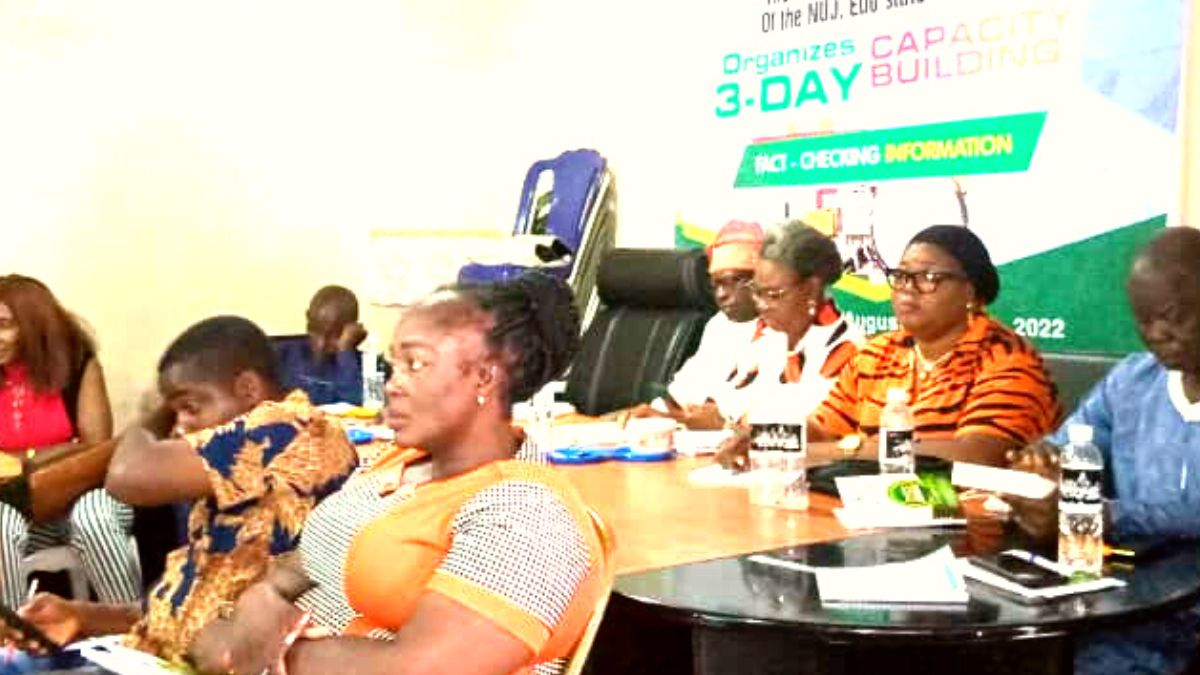
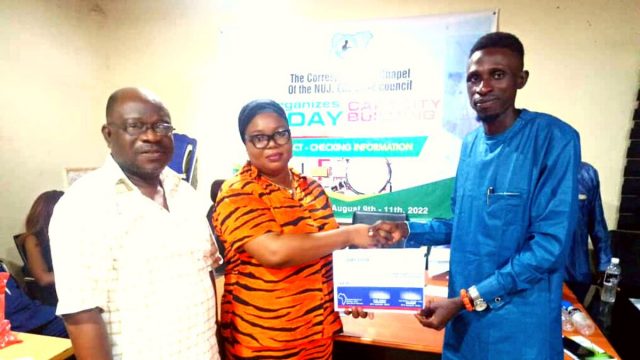
Ahead of the 2023 general elections, the Correspondents’ Chapel of the Edo State Council of the Nigerian Union of Journalists, NUJ, has commenced building the capacity of its members especially in the deployment of technology in election reportage to avoid the pitfall of spreading inaccurate or fake news that could mislead the public using the instrumentality of fact-checking.
State chairman of the Correspondents’ Chapel, Nefishetu Yakubu, at a training programme on “Fact-Checking Information” on Tuesday, noted that election periods were usually engulfed with fake and unconfirmed news reports, which have ther tendency to jeopardise the processes. She said in this era of misinformation, it was the intention of the chapel’s executive to build the capacity of members on how to deploy technology to counter fake news that are more pervasive, particularly on our social media than ever before.
In his remarks at the event, the state chairman of the NUJ, Festus Alenkhe, urged the Independent National Electoral Commission (INEC) to expand the capabilities of journalists in checking election results in real-time on its viewing portal that was recently introduced.
Yakubu, a correspondent of the News Agency of Nigeria, NAN, stated that “There is no doubt that opportunities now abound in technological innovations, hence these can be used to verify and counter fake news during electoral process”, adding that “Studies have shown that in recent times, technologies have helped to unravel the truth behind some controversial issues in Nigeria’s political space”.
She recalled that “Just a few weeks ago, news about a purported two months extension of the Continuous Voters Registration (CVR) by the Independent National Electoral Commission, (INEC) made the rounds in major newspapers, including platforms that have built their reputation and credibility over the years. The report was, however, later found to be untrue. Unfortunately, no matter how close it is, and how “credible” the platform that reported it is, as far as it’s untrue, it’s tagged as fake news”.
Yakubu regretted that scenarios also abound whereby individuals and groups used their social media platforms to peddle fake news around electoral processes, malpractices, electoral violence and even fake election results. These, she posited, have continued to exacerbate mutual distrust amongst electoral stakeholders in Nigeria, the media inclusive.
Consequently, ahead of the 2023 general elections, she said it had become necessary to arm journalists with Fact-checking tools “to expose series of misleading false information, which may be doctored to misinform the public”.












 WhatsApp us