Kara Bridge Repairs Trigger Hours-Long Gridlock on Lagos-Ibadan Expressway as Commuters Stranded
Motorists face severe delays as phased expansion-joint repairs at Kara Bridge send traffic queues stretching deep into Lagos, with authorities deploying multiple agencies to manage the two-week project.
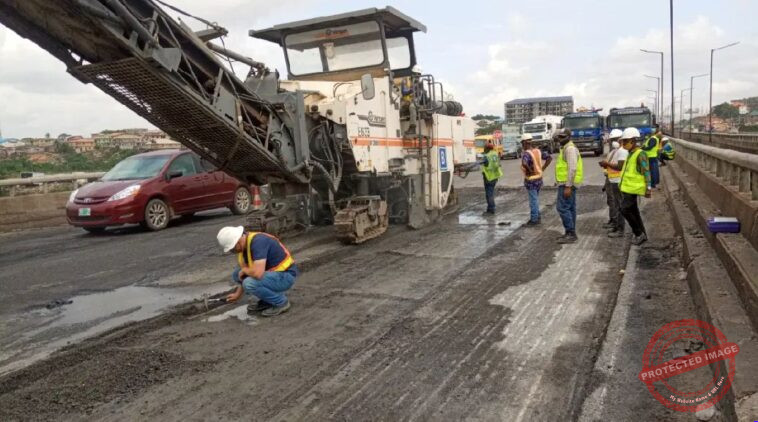
Motorists and commuters on the Lagos-Ibadan Expressway are facing severe traffic congestion following the commencement of repairs on damaged expansion joints at the Kara Bridge.
The repair work began on Tuesday, September 8, 2026, and is expected to continue until September 22, with the two-week intervention already causing major disruption along one of Nigeria’s busiest highways.
The project, directed by Works Minister David Umahi, involves the replacement of expansion joints that federal authorities say have exceeded their service life and require urgent attention to prevent further deterioration and potential safety risks.
Although the Kara Bridge has not been completely closed, the traffic restrictions introduced for the project have resulted in significant delays.
Under the current arrangement, contractors are working on approximately 100 metres of the affected section at a time. One half of the stretch is closed to construction while traffic is directed through the remaining half under the supervision of traffic management officials. After about a week, the contractors are expected to move to the opposite side.
However, the phased approach has not prevented serious congestion.
Traffic began building up around the Kara Bridge on Tuesday and reportedly stretched deep into Lagos, affecting motorists around the 7Up/Toll Gate area, Secretariat, Ojota and Berger, with congestion extending towards the Otedola Underpass, Ikeja and Agege.
Several motorists were reportedly trapped in traffic for hours, while some commercial transport operators increased fares as commuters struggled to get to their destinations.
The situation remained difficult on Wednesday morning, with traffic queues reportedly forming as early as 5:30 a.m. Commuters described long delays that caused some people to miss work, appointments and other engagements.
There were also reports of some motorists driving against the normal flow of traffic in an attempt to escape the congestion, raising additional concerns about road safety.
In response, multiple traffic and security agencies have been deployed to the corridor. Personnel from the Lagos State Traffic Management Authority (LASTMA), Federal Road Safety Corps (FRSC), Ogun State Traffic Compliance and Enforcement Corps (TRACE), police and the military are working to manage the flow of vehicles and prevent further deterioration of the situation.
Lagos State Transportation Commissioner Oluwaseun Osiyemi and Ogun TRACE officials have advised motorists using the corridor to leave home earlier than usual, prepare for extended journey times and consider alternative routes where possible.
Motorists have also been urged to cooperate with traffic officials and avoid actions that could worsen the already difficult situation.
The commencement of the repair work follows earlier delays to the project. Previous plans had indicated that the intervention could begin in August, while some earlier notices pointed to a possible start in late July. The plans were subsequently postponed following concerns over traffic management and the level of advance notice given to road users.
Expansion joints play an important role in bridge construction by allowing sections of a bridge to accommodate movement caused by temperature changes, traffic loads and other structural factors. When the joints deteriorate or reach the end of their service life, repairs become necessary to maintain the safety and functionality of the structure.
Authorities have therefore maintained that the current work is necessary despite the inconvenience it is causing motorists.
The Lagos-Ibadan Expressway is a critical transport corridor linking Lagos with Ogun State and providing access to several other parts of Nigeria. Because of the enormous volume of vehicles using the route every day, restrictions around a relatively small section can quickly create traffic queues stretching several kilometres.
For thousands of commuters who depend on the highway daily, the major concern now is whether the traffic management measures can contain the disruption while contractors complete the repairs within the scheduled two-week period.
With the project expected to continue until September 22, 2026, motorists using the Kara axis are being advised to plan their journeys carefully, leave earlier than normal, obey instructions from traffic management personnel and consider alternative routes where practical.

 Shola Akinyele
18 Views
Shola Akinyele
18 Views













 WhatsApp us
Comments